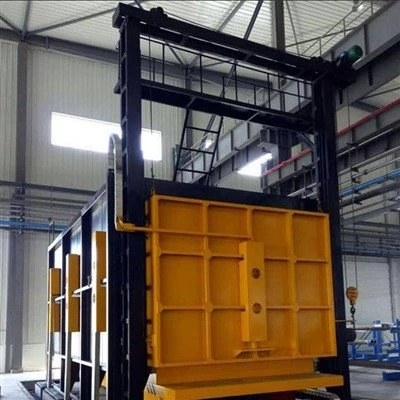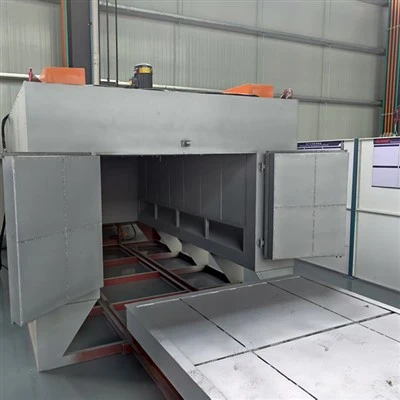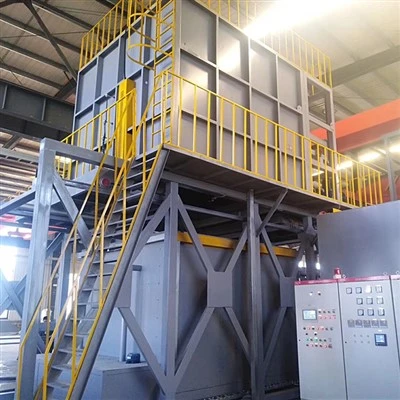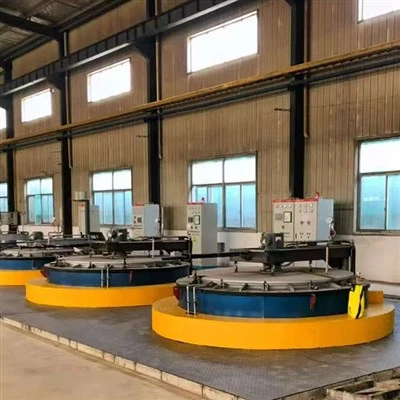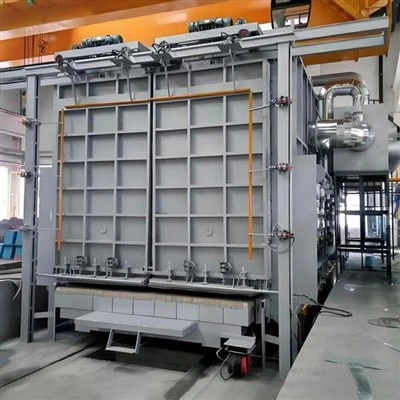
The furnace framework is assembled and welded on-site using various large and medium-sized structural steel sections, while the outer casing consists of color-coated steel panels. The furnace lining utilizes high-alumina, all-fiber refractory spun-blanket modules, ensuring excellent sealing and energy-saving performance.
The furnace car features impact-resistant sealing bricks, and the furnace door employs a spring-loaded clamping mechanism to automatically seal against the car and door frame. The unit features an integrated rail design, requiring no special foundation and allowing for immediate use upon placement on level ground. The car's refractory masonry utilizes a high-alumina shaped-brick structure, ensuring a tight seal with the furnace body and high compressive strength.
The furnace door features a composite structure of high-alumina all-fiber refractory spun-blankets and a structural steel frame; it is raised and lowered via an electric hoist. The sealing mechanism employs a cam-based, spring-loaded automatic clamping system (using long and short levers) combined with a soft-edge sealing device.
Heating is provided by high-velocity burners evenly distributed on both sides of the furnace body. These burners achieve discharge velocities of 100–150 m/s, intensifying convective heat transfer and enhancing internal airflow circulation to maintain temperature uniformity within ±10°C. Each burner is equipped with an independent, comprehensive combustion controller featuring automatic ignition, flame detection, and automatic gas shut-off upon flame failure. The combustion system supports continuous proportional regulation.
The exhaust stack is equipped with components such as an automatic furnace pressure control system and a butterfly valve to regulate cooling rates. A pressure transmitter monitors furnace chamber pressure; the system compares the reading against the setpoint and sends a signal to the stack actuator. By adjusting the stack opening, the system automatically controls chamber pressure, achieving zero-pressure control and a fully sealed environment.
The equipment includes interlocking safety devices-such as interlocks between the furnace car and door (locking the car if the door is not fully open or if the car seal is not disengaged) and combustion system safeguards (preventing startup or triggering automatic shutdown if air, fuel, or compressed air pressures are insufficient)-to prevent malfunctions or accidents caused by operational errors.
The equipment features a high degree of automation, with electric controls for the furnace door and car. Combustion, temperature, and pressure parameters are automatically regulated. Pipeline pressures for combustion air and fuel can be preset and automatically adjusted to maintain the optimal air-fuel ratio.