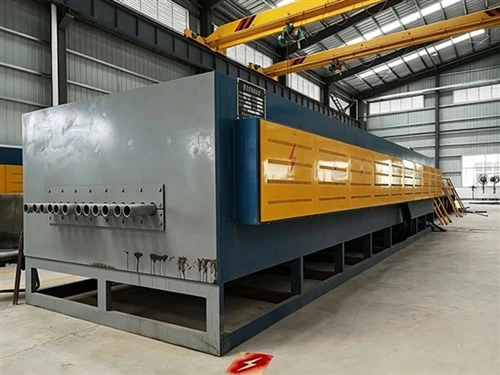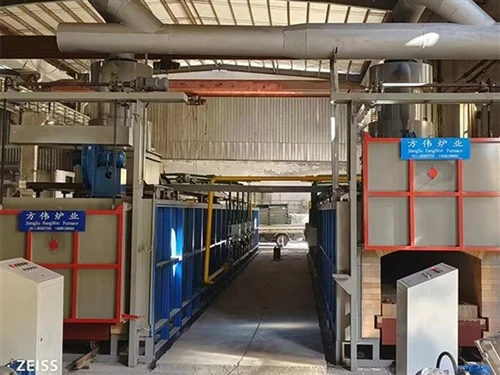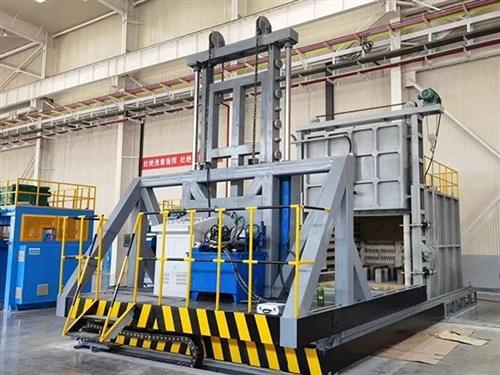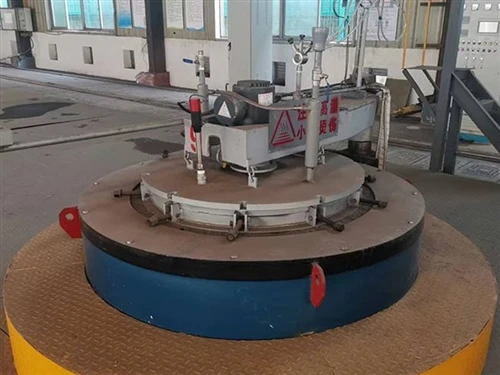
The pit-type furnace primarily consists of an outer cover, an inner cover, a convection cylinder, burners, a hearth circulation fan, a rapid cooling fan, and a methanol cracking unit.
1. Outer Cover
The outer cover is composed of a steel shell, furnace lining, and a lifting beam; it serves as the structural framework for the entire furnace assembly. A pair of guide rings at the bottom fits over guide posts of slightly varying heights on either side of the furnace base, ensuring the centerlines of the outer cover and the furnace base align perfectly.
2. Inner Cover
The inner cover separates the flue gas flow space from the controlled atmosphere space surrounding the workpiece and acts as the heat exchange surface. It features excellent sealing, high temperature and oxidation resistance, and sufficient rigidity; its design maximizes heat exchange area while minimizing deformation and extending service life.
3. Convection Cylinder
The convection cylinder separates the material to be treated from the inner cover and provides a flow path for the controlled atmosphere. Hot gas flows upward through the annular gap between the convection cylinder and the inner cover, then reverses direction to flow downward into the material stack. The gas velocity within the annular gap remains high and constant, facilitating heat transfer between the gas flow and the inner cover.
4. Hearth Circulation Fan
A circulation fan is installed in the center of the furnace hearth. During heating, the circulating controlled atmosphere passes through the annular gap between the convection cylinder and the inner cover, absorbing heat from the inner cover and transferring it to the workpiece. The fan operates throughout the cooling phase, generating strong convection within the loading space to transfer heat from the workpiece to the inner cover. It is driven by a variable-frequency motor, allowing speed adjustment based on furnace temperature; this system offers precise speed control and ease of operation and maintenance.
5. Burners
The burner system comprises burners, a blower, piping, and an exhaust flue. Eight burners are arranged in two rows tangentially to the outer cover, promoting uniform furnace temperature and minimizing localized overheating of the inner cover. These burners directly heat the inner cover and serve as the furnace's heat source.
6. Methanol Cracking Furnace
The methanol cracking furnace utilizes the CO and H₂ generated from the high-temperature cracking of methanol; these gases enter a pit-type furnace as a mixed gas stream to facilitate the required heat treatment process. Comprising a feed system, vaporization chamber, heat exchanger, and temperature control system, the furnace plays a crucial role in ensuring process stability.